The Post Graduate Diploma in Emergency Health Care (PGDEHC) is designed to equip healthcare professionals and aspirants with advanced knowledge and practical skills in emergency and pre-hospital care.

A Premier initiative of the AISECT Group of Universities

Why Join the BBA in Hospital Administration?

This 3-year degree prepares students to manage hospitals and healthcare organisations effectively. The program combines business administration, healthcare management, and hands-on training, helping students develop the skills required for modern hospital operations.

Students graduate with strong foundation skills in management, problem-solving, hospital systems, quality control, and patient service.

Develop comprehensive knowledge of emergency healthcare systems and protocols.

Acquire critical skills in pre-hospital care, trauma management, and life support.

Apply evidence-based practices in patient assessment, stabilization, and transport.

Start date

11th June

Duration

1 years

Eligibility

Bachelors degree in health-related discipline

Girl Image

Go beyond the basics with a curriculum Engineered for Real-World Application


  • Online Interactive Learning Modules
  • 30-day Campus Immersion
  • Capstone project and dissertation in the final semester.

We collaborate with 100+ leading universities and companies

Application Process

  • Submit your Application

    Start your journey by submitting your applocation to the Redversity program.

  • Get Shortlisted

    If selected, you’ll be shortlisted based on your qualifications and profile.

  • Fees Payment

    Shortlisted canditate should clear the initial fee payment to block the bathc seat.

  • Confirmation

    Post fee confirmation the candidate will receive an official confirmation email

Get Started with Admissions

Share your details and our team will personally reach out to assist you.

    I authorize RedVersity and its representatives to Call, SMS, Email or WhatsApp me about its updates and notifications. This consent overrides any registration for DND / NDNC.
    We respect your privacy. Your information is safe with us.

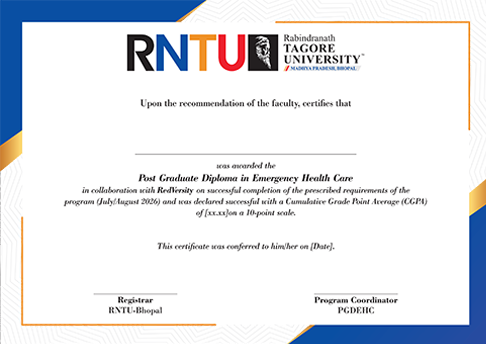
    Your dedication deserves recognition.

    Upon completion, youll proudle receive the official certificate.

    Cetificate

    Detailed Program Modules

    A 1-year online program (2 semesters) with clinical campus immersion, preparing healthcare professionals in pre-hospital care, trauma management, and advanced life support for diverse emergency settings.

    Module 1: Introduction to Emergency Health Care
    Provides a comprehensive overview of the emergency healthcare ecosystem, including the roles of EMTs, paramedics, and hospital teams, as well as global standards and systems in emergency care delivery.
    Module 2: Anatomy & Physiology for Emergency Care
    Builds foundational knowledge of human body systems relevant to emergency situations, enabling accurate patient assessment and understanding of physiological responses to trauma and illness.
    Module 3: Patient Assessment & Triage
    Teaches structured patient evaluation techniques and triage protocols used to prioritise care during mass casualty events and multi-patient emergency scenarios.
    Module 4: Basic Life Support (BLS) & First Aid
    Trains students in CPR, AED usage, airway management, wound care, and essential first-aid interventions for stabilising patients before advanced care is available.
    Module 5: Pre-hospital Emergency Care Systems
    Explores the organisation and functioning of pre-hospital care, including ambulance operations, emergency dispatch, patient transport protocols, and inter-agency coordination.
    Module 6: Clinical Skills Lab – Simulations
    Campus immersion module focusing on hands-on clinical skill development using mannequins, simulation labs, and case-based practice in a controlled healthcare environment.
    Module 7: Advanced Life Support (ALS)
    Covers advanced interventions including cardiac monitoring, defibrillation, intravenous access, advanced airway management, and pharmacological support in critical care situations.
    Module 8: Trauma & Critical Care Management
    Addresses the assessment and treatment of major trauma including head injuries, spinal trauma, burns, and multi-system injuries, with emphasis on rapid stabilisation and transport.
    Module 9: Pediatric & Obstetric Emergencies
    Focuses on the unique physiological and clinical considerations in managing emergencies involving infants, children, and pregnant patients in pre-hospital and emergency settings.
    Module 10: Disaster Management & Mass Casualty Response
    Prepares students to function effectively within disaster medical response teams, covering mass casualty triage, field hospital setup, and coordination with disaster management agencies.
    Module 11: Emergency Pharmacology & Equipment
    Introduces commonly used emergency medications, their indications, dosages, and administration routes, alongside the operation and maintenance of emergency medical equipment.
    Module 12: Capstone Project / Simulation Exercises
    Students manage a simulated real-world emergency scenario from initial response to patient handover, integrating all clinical and operational competencies from the program.

    FAQ’s

    The RedVersity EMT-Basic curriculum is designed to move from foundational knowledge to high-pressure life-saving techniques.

    What skills are taught in the PG Diploma in Emergency Health Care?
    • The program focuses on Advanced Life Support (ALS), Trauma Management, Patient Assessment & Triage, and Mass Casualty Response. It prepares students to handle critical medical emergencies and pre-hospital care.
    What is the eligibility for the PGDEHC program?
    • Eligible candidates include those with a Bachelor’s degree in a health-related discipline (Nursing, MBBS, Physiotherapy, etc.) or Diploma holders in Paramedical fields with at least one year of work experience.
    Is there a clinical practice component in this PG Diploma?
    • Yes. The course integrates online learning with intensive campus immersions (15 days per semester) focusing on clinical skills labs and real-world emergency scenario simulations.
    What career paths are available after completing PGDEHC?
    • Graduates are equipped for roles such as Emergency Medical Technician (EMT), Paramedic, Trauma & Critical Care Associate, or Hospital Emergency Department Coordinator.
    How many credits is the PGDEHC program worth?
    • The program consists of a total of 30 credits distributed equally across two semesters (15 credits per semester).