The program integrates business administration principles with healthcare service management, enabling students to acquire skills in planning, coordination, leadership, and quality control specific to hospital and healthcare settings.

A Premier initiative of the AISECT Group of Universities

Why Join the BBA in Hospital Administration?

This 3-year degree prepares students to manage hospitals and healthcare organisations effectively. The program combines business administration, healthcare management, and hands-on training, helping students develop the skills required for modern hospital operations.

Students graduate with strong foundation skills in management, problem-solving, hospital systems, quality control, and patient service.

Provide a strong foundation in business administration with a focus on healthcare institutions.

Develop managerial, operational, and leadership competencies specific to the hospital environment.

Encourage innovation and entrepreneurship within the healthcare sector.

Start date

11th March

Duration

3 years

Eligibility

10+2

Girl Image

Go beyond the basics with a curriculum Engineered for Real-World Application


  • Core management courses in finance, marketing, HR, and organizational behavior.
  • Specialized subjects in hospital and healthcare management.
  • Training in healthcare information systems and data analytics.
  • Hands-on exposure through internships and hospital visits.
  • Capstone project and dissertation in the final semester.

We collaborate with 100+ leading universities and companies

Application Process

  • Submit your Application

    Start your journey by submitting your applocation to the Redversity program.

  • Get Shortlisted

    If selected, you’ll be shortlisted based on your qualifications and profile.

  • Fees Payment

    Shortlisted canditate should clear the initial fee payment to block the bathc seat.

  • Confirmation

    Post fee confirmation the candidate will receive an official confirmation email

Get Started with Admissions

Share your details and our team will personally reach out to assist you.

    I authorize RedVersity and its representatives to Call, SMS, Email or WhatsApp me about its updates and notifications. This consent overrides any registration for DND / NDNC.
    We respect your privacy. Your information is safe with us.

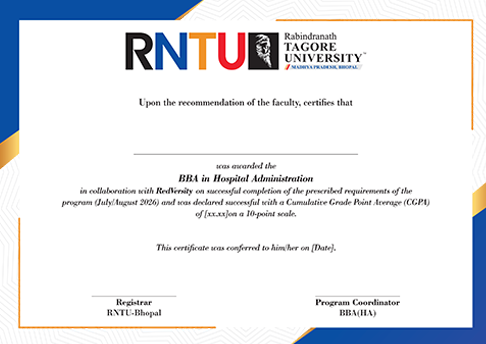
    Your dedication deserves recognition.

    Upon completion, youll proudle receive the official certificate.

    Cetificate

    Detailed Program Modules

    A 3-year undergraduate program (6 semesters) combining business administration with healthcare management, producing industry-ready graduates equipped to lead hospital operations, healthcare quality, and administrative functions.

    Module 1: Principles of Management
    Introduces core management theories, functions of planning, organising, leading, and controlling, and their application to healthcare and business organisational contexts.
    Module 2: Business Communication
    Develops professional communication skills including report writing, presentations, and interpersonal communication essential for effective hospital and healthcare administration.
    Module 3: Introduction to Healthcare Systems
    Provides an overview of healthcare delivery models, hospital hierarchies, public and private health systems, and the evolving landscape of healthcare in India and globally.
    Module 4: Financial Accounting
    Covers fundamental accounting principles, preparation of financial statements, and interpretation of accounts relevant to managing healthcare institutional finances.
    Module 5: Business Economics
    Introduces micro and macroeconomic concepts including demand-supply analysis, market structures, and economic decision-making as applied to healthcare resource allocation.
    Module 6: Computer Applications in Management
    Equips students with practical skills in productivity tools, healthcare software basics, and digital literacy needed for modern hospital administration roles.
    Module 7: Environmental Studies
    Covers environmental awareness, sustainability principles, and the responsibilities of healthcare institutions in managing biomedical waste and ecological impact.
    Module 8: Organisational Behavior
    Explores individual and group dynamics, motivation, leadership styles, and conflict resolution within healthcare organisations and hospital team structures.
    Module 9: Marketing Management
    Introduces marketing principles adapted to healthcare, including patient engagement strategies, hospital branding, service design, and community outreach planning.
    Module 10: Hospital Operations Management
    Covers the day-to-day management of hospital departments, workflow optimisation, bed management, OPD and IPD coordination, and operational efficiency strategies.
    Module 11: Human Resource Management
    Addresses recruitment, training, performance appraisal, workforce planning, and HR policies specific to managing clinical and non-clinical hospital staff.
    Module 12: Business Statistics
    Introduces statistical methods for data collection, analysis, and presentation, providing tools for evidence-based decision-making in healthcare management.
    Module 13: Medical Terminology and Anatomy Basics
    Builds foundational knowledge of medical language and basic human anatomy, enabling administrators to communicate effectively with clinical teams and understand patient care processes.
    Module 14: Value Education and Ethics
    Instils professional ethics, social responsibility, and value-based leadership principles relevant to managing healthcare institutions with integrity and accountability.
    Module 15: Healthcare Quality Management
    Covers quality assurance frameworks, accreditation standards (NABH/JCI), patient safety protocols, and continuous quality improvement methodologies in hospital settings.
    Module 16: Financial Management
    Addresses hospital budgeting, cost analysis, financial planning, and performance evaluation, equipping students to manage the fiscal health of healthcare organisations.
    Module 17: Health Information Systems
    Explores electronic health records, hospital management software, data governance, and the use of IT infrastructure to improve hospital efficiency and patient outcomes.
    Module 18: Hospital Planning and Design
    Covers principles of hospital architecture, functional planning of departments, infection control layouts, capacity planning, and regulatory compliance in hospital construction.
    Module 19: Legal Aspects of Healthcare
    Examines medical law, patient rights, consent frameworks, medico-legal cases, and the legal obligations of hospitals and healthcare administrators.
    Module 20: Research Methodology
    Introduces qualitative and quantitative research methods, literature review techniques, and data analysis skills applicable to healthcare administration research.
    Module 21: Summer Internship / Field Project
    Students undertake a structured hospital or healthcare organisation placement to gain first-hand exposure to administrative operations and practical management challenges.
    Module 22: Operations Research
    Introduces quantitative techniques including linear programming, queuing theory, and simulation modelling used for optimising hospital resource use and operational planning.
    Module 23: Health Economics
    Examines economic principles applied to healthcare financing, insurance models, health technology assessment, and the economics of hospital management.
    Module 24: Hospital Supply Chain Management
    Covers procurement, inventory control, vendor management, and logistics for medical supplies, pharmaceuticals, and equipment in hospital environments.
    Module 25: Patient Care Management
    Focuses on systems and strategies for delivering safe, patient-centred care including service standards, complaint management, and patient experience improvement.
    Module 26: Public Health Administration
    Explores the administration of public health programs, national health policies, government schemes, and the role of hospitals in community and preventive health.
    Module 27: Data Analytics in Healthcare
    Introduces tools and techniques for analysing clinical and operational data, including dashboards, KPI monitoring, and predictive analytics for hospital performance management.
    Module 28: Soft Skills and Personality Development
    Develops leadership presence, team communication, emotional intelligence, and professional etiquette essential for administrative roles in healthcare environments.
    Module 29: Strategic Management
    Covers strategic planning frameworks, competitive analysis, organisational vision, and strategic implementation relevant to managing healthcare institutions for growth and sustainability.
    Module 30: Healthcare Marketing
    Focuses on advanced healthcare marketing strategies, digital health promotion, patient acquisition, reputation management, and competitive positioning of hospitals.
    Module 31: Hospital Financial Administration
    Addresses advanced financial topics including capital budgeting, revenue cycle management, healthcare costing, and financial performance reporting for hospitals.
    Module 32: E-Hospital Management Systems
    Explores digital transformation in hospitals, including EHR integration, telemedicine platforms, patient portals, and the implementation of e-hospital systems.
    Module 33: Health Insurance and TPA Management
    Covers the structure of health insurance, third-party administrator (TPA) processes, cashless claims management, and hospital-insurer coordination.
    Module 34: Entrepreneurship in Healthcare
    Encourages innovative thinking in healthcare, covering startup ecosystems, business model development, funding strategies, and launching ventures in healthcare and digital health.
    Module 35: Minor Project / Industry Internship
    A focused project or industry engagement that allows students to explore a specific area of hospital management and develop applied problem-solving capabilities.
    Module 36: Disaster and Risk Management in Hospitals
    Covers hospital disaster preparedness, emergency response planning, mass casualty management, and business continuity strategies for healthcare facilities during crises.
    Module 37: Global Healthcare Management
    Explores international healthcare systems, cross-border health policies, global hospital networks, and the management challenges of healthcare in a globalised environment.
    Module 38: Hospital Accreditation and Quality Standards
    In-depth study of accreditation bodies (NABH, JCI), documentation requirements, audit processes, and strategies for achieving and maintaining quality certification.
    Module 39: Health Policy and Ethics
    Examines health policy development, ethical decision-making frameworks, bioethics, and the responsibilities of healthcare administrators in policy advocacy and compliance.
    Module 40: Project Management
    Introduces project management methodologies (PMBOK, Agile) applied to healthcare settings, covering project planning, execution, monitoring, and evaluation.
    Module 41: Capstone Project / Dissertation
    Students undertake an independent research-based project addressing a real hospital management challenge, demonstrating their ability to integrate and apply learning from across the program.

    FAQ’s

    The RedVersity EMT-Basic curriculum is designed to move from foundational knowledge to high-pressure life-saving techniques.

    What is a BBA in Hospital Administration and who should enroll?
    • The BBA in Hospital Administration is a three-year undergraduate program that blends business principles with healthcare management. It is ideal for students who want to manage healthcare institutions, focusing on hospital operations, quality control, and leadership.
    What are the eligibility criteria for BBA Hospital Administration?
    • Candidates must have passed their $10+2$ or equivalent examination in any stream from a recognized board. Admissions are typically merit-based according to institutional guidelines.
    What subjects are covered in the BBA Hospital Administration syllabus?
    • The curriculum includes core management subjects like Finance and HR, alongside specialized healthcare topics such as Hospital Operations Management, Medical Terminology, Healthcare Quality Management, and Legal Aspects of Healthcare.
    What are the career opportunities after a BBA in Hospital Administration?
    • Graduates can pursue roles such as Hospital Administrator, Healthcare Quality Executive, Health Insurance Coordinator, or Patient Care Manager. They can work in hospitals, consulting firms, insurance companies, or healthcare startups.
    Can I pursue an MBA after completing this BBA degree?
    • Yes. Graduates are well-prepared to pursue higher studies such as an MBA (Master of Business Administration), MHA (Master of Health Administration), or MPH (Master of Public Health) to reach senior leadership positions.